

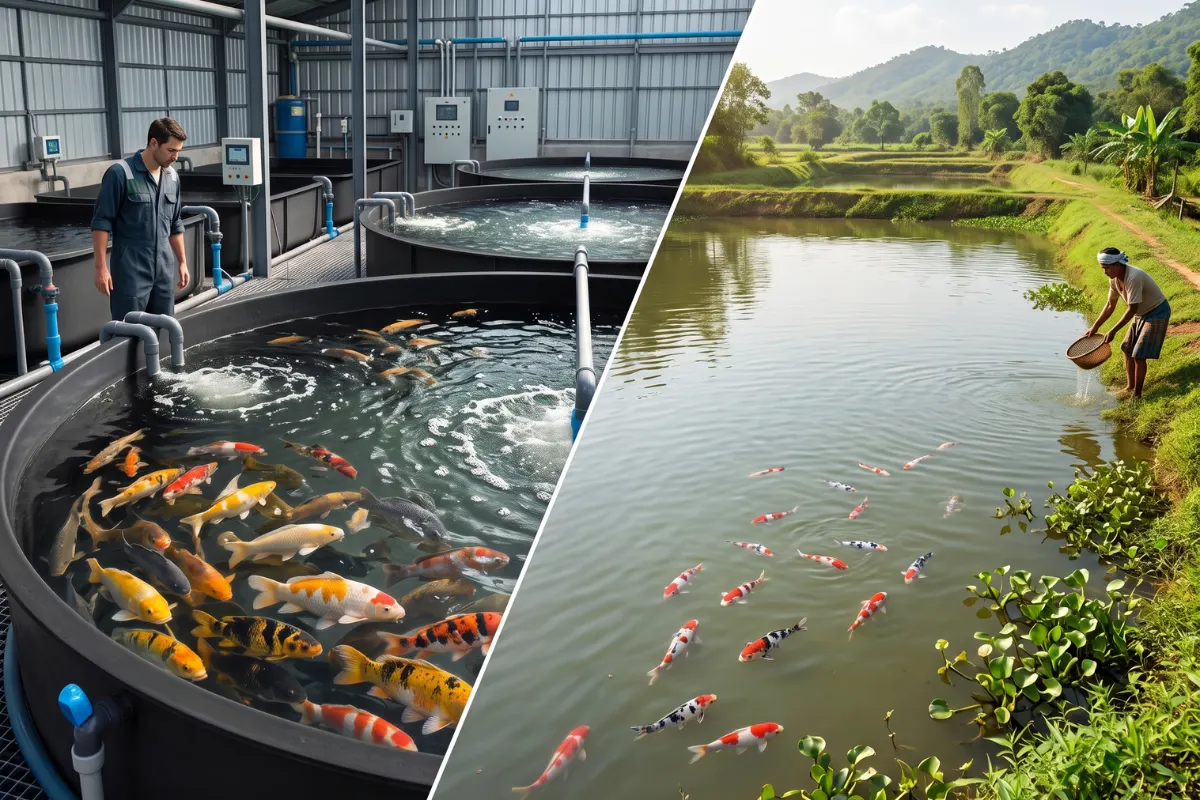
Fish farming has become an increasingly attractive option for commercial and small-scale aquaculture. However, choosing the right production system can have a major impact on investment, operating costs, space requirements, and profitability. Two common approaches are Biofloc Fish Tanks and traditional fish ponds. While both can support fish production, they work in very different ways.
A biofloc system focuses on intensive fish farming in a controlled environment, while a traditional fish pond generally relies on a larger water area and more natural pond conditions. The more profitable option depends on factors such as available land, water supply, stocking density, management skills, electricity costs, and the type of fish being farmed.
What Are Biofloc Fish Tanks?
Biofloc Fish Tanks are specially designed tanks used for intensive fish farming. The system uses beneficial microorganisms to convert certain organic waste compounds into microbial biomass. This process helps manage water quality while making better use of nutrients within the culture system.
Unlike a conventional pond, a biofloc tank operates as a more controlled aquaculture environment. Fish are raised in a relatively compact area, while aeration and regular monitoring help maintain suitable conditions.
A typical Biofloc Tank System includes:
- A suitable fish farming tank
- Continuous aeration
- Water quality monitoring
- Beneficial microbial activity
- Controlled feeding
- Regular system management
The system is particularly attractive where land is limited and farmers want to produce fish using a relatively compact setup.
What Is Traditional Fish Farming?
A Traditional Fish Pond is a larger water-based farming system where fish are raised in a pond or reservoir. Depending on the farming method, the pond may rely on natural biological processes along with supplementary feeding and water management.
Traditional ponds can be suitable for farmers who have sufficient land and access to an appropriate water source. They can also support larger water volumes, which may provide greater buffering capacity when environmental conditions change.
However, traditional pond farming generally requires more land. Preparing the site, managing water levels, controlling weeds, maintaining pond conditions, and protecting fish from predators can also add to the workload.
Biofloc vs Traditional Fish Farming: Key Difference
The biggest difference is how the farming environment is managed.
Biofloc farming uses a controlled tank-based system with intensive aeration and microbial management. Traditional pond farming uses a larger water body and generally has more interaction with the surrounding environment.
Land Requirement
Biofloc systems can produce fish in a smaller area because production is concentrated inside tanks. This can be useful for farmers who do not have large agricultural plots.
Traditional ponds require considerably more space. However, farmers who already own suitable land may find pond-based farming more practical because they do not need to create a compact intensive system.
Water Management
Water management is critical in both systems, but the approach differs.
In a biofloc system, water quality needs regular monitoring because fish are kept at relatively high densities. Aeration is especially important because the microorganisms and fish both depend on adequate oxygen availability.
Traditional ponds generally contain a much larger volume of water. This can provide greater stability, but water quality still needs to be monitored and managed throughout the production cycle.
Stocking Density
One of the major advantages of Biofloc Fish Farming is its potential for intensive production. Because the system is designed around controlled water conditions and continuous aeration, it can support higher stocking densities than many conventional pond systems.
However, higher stocking density also means greater management responsibility. Poor aeration, overfeeding, or inadequate monitoring can quickly affect the system.
What Makes Biofloc Fish Farming Profitable?
The profitability of Biofloc Fish Farming does not come simply from using tanks. Its economic advantage comes from combining higher production potential with efficient use of space and water.
A well-managed system can offer several advantages:
- Higher production from limited land
- Better control over the farming environment
- Potentially reduced water exchange
- More intensive use of available space
- Greater control over feeding and daily operations
- Suitability for areas where large ponds are impractical
However, these advantages come with additional responsibilities. Aeration equipment must operate reliably, water parameters need monitoring, and the system requires disciplined management.
What Makes Traditional Fish Ponds Profitable?
Traditional ponds can remain highly practical where land and water are readily available. Their main advantage is their relatively simple operating model and ability to support larger water bodies.
Farmers may benefit from:
- Lower system complexity
- Larger available water volume
- Established pond management practices
- Greater suitability for larger land areas
- Potentially lower dependence on continuous mechanical aeration
However, profitability can vary significantly depending on land preparation, water availability, fish stocking levels, feed costs, mortality, disease management, and market prices.
Cost Comparison: Biofloc vs Traditional Fish Ponds
Profitability starts with understanding the total cost of running each system. A Biofloc Fish Tank may require a higher level of equipment and technical management at the beginning. Aeration systems, tank infrastructure, water testing, and regular monitoring are important parts of the setup.
Traditional fish ponds can require more land preparation, excavation, pond development, and water management. However, the exact investment varies considerably depending on land conditions, pond size, water availability, and local construction costs.
Instead of comparing only the initial investment, farmers should consider the complete operating cost over the production cycle.
Important cost factors include:
- Tank or pond construction
- Land preparation
- Fish seed
- Feed
- Electricity
- Aeration
- Water management
- Labour
- Health and disease management
- Maintenance
- Harvesting and transportation
Which System Has Lower Operating Costs?
There is no universal answer. The cheaper system depends on the farm’s location, scale, management practices, and available resources.
A biofloc system can use land and water efficiently, but continuous aeration means electricity is an important operating expense. The system also requires regular monitoring and skilled management.
Traditional ponds may have lower equipment requirements, particularly where suitable land and water are already available. However, larger pond areas can increase land, water, labour, and maintenance requirements.
Therefore, Fish Farming Cost should be calculated according to the specific project rather than assuming that one system is always cheaper.
Which System Can Generate Higher Profit?
Biofloc Fish Farming Profit can be attractive when the system is properly managed and the available space is limited. Higher production intensity can allow farmers to generate more output from a smaller area.
However, higher production potential also brings greater operational risk. Aeration failure, poor water quality, overfeeding, or inadequate monitoring can affect fish survival and production.
Traditional fish ponds can also be profitable, especially when farmers have suitable land and established infrastructure. Their larger water volume can provide a different operating environment and may be easier to manage for farmers familiar with conventional aquaculture.
In both cases, profitability depends on:
- Fish species and growth rate
- Stocking density
- Feed conversion
- Mortality rate
- Electricity costs
- Labour expenses
- Production cycle
- Selling price
- Local market demand
So, the most profitable system is not necessarily the one with the highest stocking density. Efficient management and controlled costs are equally important.
Biofloc Fish Tank Setup: What Farmers Need
A successful Biofloc Fish Tank Setup requires more than simply installing a tank and adding fish. The system needs appropriate infrastructure and regular monitoring.
Depending on the project, this may include:
- Suitable fish farming tanks
- Aeration equipment
- Air distribution systems
- Water quality testing equipment
- Reliable electricity supply
- Fish seed
- Appropriate feed
- Microbial management
- Regular observation and maintenance
Aeration is particularly important because dissolved oxygen must remain within a suitable range for the fish and microbial community.
Risks to Consider Before Choosing a System
Every aquaculture model has risks. Understanding them before investing can prevent unrealistic expectations.
Biofloc Risks
Biofloc systems can be sensitive to management errors. High stocking densities leave less room for poor water-quality control.
Potential risks include:
- Power failure
- Aeration failure
- Poor water quality
- Incorrect feeding
- Inadequate microbial management
- Higher technical requirements
Traditional Pond Risks
Traditional ponds also face several challenges. Because they are generally exposed to the surrounding environment, external factors can influence pond conditions.
Potential issues include:
- Water availability
- Disease
- Predators
- Algae and weed growth
- Water-quality fluctuations
- Weather conditions
- Higher land requirements
Good farm planning can reduce these risks in either system.
Which System Is Better for Different Farmers?
There is no single answer to Biofloc vs Traditional Fish Farming. The better option depends on the farmer’s resources and objectives.
Biofloc May Be Better When:
- Land availability is limited.
- Intensive production is the objective.
- Reliable electricity is available.
- The farmer can monitor water quality regularly.
- Technical management is possible.
- Efficient water use is a priority.
Traditional Ponds May Be Better When:
- Large areas of suitable land are available.
- Reliable water resources are accessible.
- The farmer already has pond infrastructure.
- A less equipment-intensive system is preferred.
- The farmer has experience with conventional pond management.
The right decision should therefore be based on available resources, production goals, and management capability, rather than profitability claims alone.
Why Choose Centennial Fabrics Limited for Fish Farming Tanks?
Centennial Fabrics Limited manufactures technical textile solutions for applications across aquaculture, agriculture, water storage, and other industries. Our product range includes Fish Farming Tanks and Flexible Water Storage Tanks, designed for applications where flexible containment and reliable material performance are required.
Our manufacturing approach focuses on:
- Consistent material quality
- Controlled production processes
- Product durability
- Quality testing
- Application-specific solutions
- Reliable technical support
For aquaculture businesses using tank-based systems, choosing a dependable tank manufacturer is an important part of building reliable infrastructure.
Conclusion
Biofloc Fish Tanks and traditional fish ponds can both be profitable, but neither system guarantees higher returns. Biofloc can provide an efficient option where land is limited and intensive fish production is required. Traditional ponds can be practical where suitable land, water, and established infrastructure are available.