

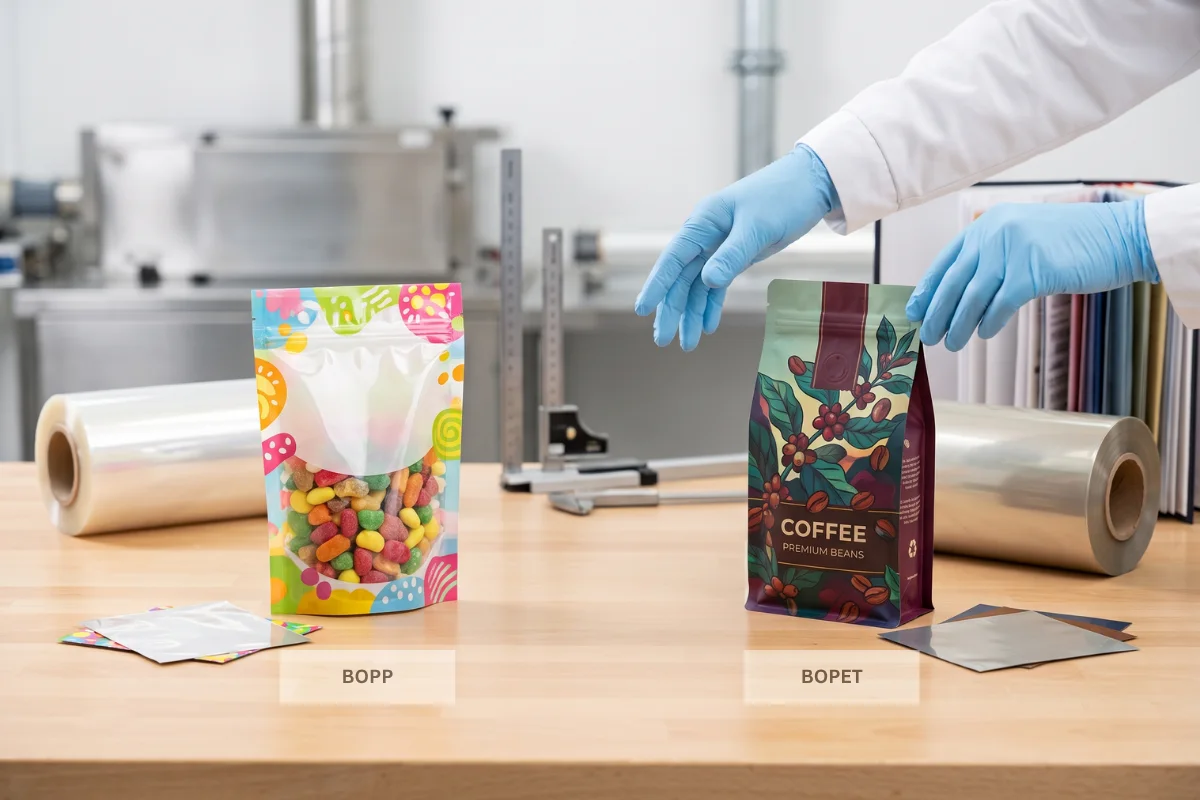
Choosing the right packaging film affects the look, strength, print quality, and performance of the final package.
BOPP Printed Films and BOPET Printed Films are widely used in flexible packaging. However, they are made from different materials. Because of this, they offer different properties and work better for different applications.
So, which one should you choose?
The answer depends on your packaging structure, printing process, production conditions, and end use. In this guide, we compare BOPP and BOPET, explain their common uses, and share the key factors to check before buying.
What Are BOPP and BOPET Printed Films?
BOPP stands for Biaxially Oriented Polypropylene. BOPET stands for Biaxially Oriented Polyethylene Terephthalate.
Both films go through a stretching process during production. The film is stretched in two directions. As a result, this process improves its physical and processing properties.
Both materials also work well for printed packaging. However, their final performance depends on the film grade, thickness, surface treatment, printing process, and packaging structure.
What Are BOPP Printed Films?
BOPP Printed Films are made from polypropylene. They are widely used in flexible packaging where lightweight construction and an attractive printed surface are important.
BOPP is used for:
- Food packaging
- Printed pouches
- Flexible packaging
- Labels
- Decorative packaging
- Laminated packaging
- Consumer packaging
BOPP can also be combined with other materials. Therefore, manufacturers can create multilayer structures for specific packaging needs.
What Are BOPET Printed Films?
BOPET Printed Films are made from polyester. They are often used when dimensional stability and mechanical performance are important.
Common applications include:
- Flexible packaging
- Laminated packaging
- Printed packaging
- Industrial packaging
- Packaging that requires dimensional stability
However, the film grade still matters. Thickness, surface treatment, printing method, and final package structure can all affect performance.
BOPP vs BOPET Printed Films: Key Differences
BOPP and BOPET are both useful packaging films. However, they are not interchangeable in every application.
| Feature | BOPP Printed Films | BOPET Printed Films |
|---|---|---|
| Base Material | Polypropylene | Polyester |
| Weight | Generally lightweight | Generally higher density |
| Dimensional Stability | Good | Generally higher |
| Mechanical Performance | Good strength | Strong mechanical performance |
| Temperature Resistance | Suitable for many standard processes | Better suited to higher processing temperatures |
| Printability | Suitable for high-quality printing | Suitable for high-quality printing |
| Appearance | Good clarity and surface appearance | Good clarity and print appearance |
| Flexibility | Suitable for flexible packaging | Suitable for flexible packaging |
| Common Applications | Food packaging, labels, pouches, laminates | Flexible packaging, laminates, industrial packaging |
In simple terms, BOPP is often preferred when lightweight packaging and appearance are important. On the other hand, BOPET is often considered when dimensional stability and mechanical performance matter more.
Where Are BOPP Printed Films Used?
BOPP is widely used in flexible packaging. It is especially useful when lightweight construction and an attractive printed surface are important.
Food Packaging
BOPP can be used in food packaging structures. However, the film must match the required barrier, sealing, and processing characteristics.
Printed Pouches
Printed BOPP works well when branding and product graphics are important.
Its surface can help create clear and attractive packaging designs.
Labels and Decorative Packaging
BOPP is also used for labels and decorative applications.
Therefore, it can be useful when product appearance is an important part of the packaging.
Laminated Packaging
BOPP can be combined with other materials to create multilayer packaging.
Where Are BOPET Printed Films Used?
BOPET is often selected when dimensional stability and mechanical performance are important.
Flexible Packaging
BOPET can form part of multilayer flexible packaging structures.
It can work with other materials to achieve the required packaging performance.
Laminated Structures
BOPET can be useful during printing, lamination, and converting.
Its dimensional stability helps support consistent processing in suitable applications.
Industrial Packaging
Depending on the film specification, BOPET can be used for industrial packaging applications that need consistent mechanical and processing performance.
Printed Packaging
BOPET can support high-quality printed graphics when the correct surface treatment and printing system are used.
How to Choose Between BOPP and BOPET?
There is no single film that is better for every package.
Instead, start with the requirements of the finished product. Then, compare the film properties against those requirements.
1. Check the Packaging Structure
First, identify how the film will be used.
For example, it may be:
- A printed layer
- A laminate layer
- Part of a multilayer structure
The complete package matters. Therefore, do not judge the film by itself.
2. Consider the Printing Process
Next, look at the printing method.
Check:
- Printing technology
- Ink system
- Surface treatment
- Required graphics
- Printing speed
- Ink adhesion
The film and printing system should be compatible. So, confirm this with the film supplier before production.
3. Check Mechanical Requirements
Packaging goes through several stages before reaching the customer.
It may face stress during:
- Manufacturing
- Filling
- Transportation
- Storage
- Handling
Because of this, the required mechanical properties should match the actual application.
4. Consider Processing Conditions
Temperature and dimensional stability can affect printing, lamination, and converting.
For demanding processes, BOPET may be suitable when its properties match the application.
However, the final decision should come from the complete processing requirement rather than one property alone.
5. Think About the Final Use
Finally, consider where the finished package will be used.
Look at:
- Product type
- Storage conditions
- Transportation
- Packaging machinery
- Expected package performance
For example, a food package may need a different structure from an industrial package.
BOPP vs BOPET: Which One Is Better?
The right choice depends on the application.
BOPP may be suitable when:
- Lightweight packaging is important.
- Appearance is a priority.
- The package needs flexible packaging performance.
- The structure suits polypropylene film.
- The printing and converting process is compatible.
BOPET may be suitable when:
- Dimensional stability is important.
- Mechanical performance is a key factor.
- Processing conditions require suitable polyester film properties.
- The packaging structure benefits from BOPET.
So, there is no universal winner.
Factors to Consider Before Buying Printed Packaging Films
Before purchasing Printed Packaging Films, give the manufacturer clear information about your application.
Check the following:
- Film type
- Film thickness
- Roll dimensions
- Printing method
- Surface treatment
- Lamination requirements
- Sealing requirements
- Packaging machinery
- Product characteristics
- Storage conditions
- Transportation requirements
- Required appearance and graphics
This information helps the manufacturer recommend a more suitable film structure.
Why Film Quality Matters in Flexible Packaging
Film quality affects more than appearance.
It can also influence printing, converting, lamination, and the performance of the final package.
For this reason, do not compare suppliers on price alone.
Instead, check:
- Consistent film quality
- Suitable specifications
- Manufacturing control
- Quality checks
- Technical support
- Application suitability
An experienced Packaging Film Manufacturer can also help you compare the available options and select a film that fits your application.
Why Choose Centennial Fabrics Limited?
Centennial Fabrics Limited provides technical textile and flexible packaging solutions for industrial and commercial applications.
Its product portfolio includes BOPP and BOPET Printed Films, along with:
Centfab focuses on consistent production, controlled processes, product quality, and application-specific requirements.
Conclusion
BOPP vs BOPET Printed Films is not a simple choice between two materials. Both films have different properties, so each one can suit different packaging requirements.
BOPP is often considered for lightweight packaging, attractive appearance, and flexible packaging applications. Meanwhile, BOPET is often considered when dimensional stability, mechanical performance, and processing conditions are more important.
Before choosing a film, look at the complete packaging structure. Check the film type, thickness, printing method, surface treatment, lamination, machinery, product, storage conditions, and final use.
Most importantly, choose the film based on what the finished package needs to do. This approach helps buyers select a more suitable material and avoid choosing a film based only on price or one individual property.